
Disclosure: Chasing Whereabouts is reader-supported. This guide contains affiliate links to partners like Tiqets, GetYourGuide and Viator. If you make a purchase through these links, we may earn a small commission at no extra cost to you. This helps us continue providing free, first-hand travel guides. Thank you for your support!
Living an hour from Cologne by train gives you a particular perspective on Karneval. I haven't spent Rosenmontag fighting for a spot along the parade route — not yet — but Frankfurt to Cologne is short enough that the Rhineland carnival is very much part of life here. You hear it on the news, you watch Cologne-based colleagues disappear for a week in February, and you develop a working understanding of what it actually is versus the tourist headline version.
Cologne Karneval is not a gentle cultural outing. It's one million people on the streets on a single Monday, alcohol flowing from breakfast, confetti in your hair for three days, and a city that essentially stops functioning for anything other than the festival. That's either an extraordinary thing to witness or a very good week to stay home, depending on your tolerance for controlled chaos.
This guide is built on research and genuine familiarity with German Rhineland carnival culture — not fabricated personal attendance. Where it matters, I'll say what I know and what you should verify closer to your dates.
Disclosure: This post contains affiliate links. If you book through these links, I may earn a small commission at no extra cost to you.
What Is Cologne Karneval?
Germans call it the fünfte Jahreszeit — the fifth season. This is not hyperbole. In the Rhineland, Karneval sits alongside spring, summer, autumn, and winter as a season in its own right, and Cologne is its capital.
Advertisement
The roots are pre-Lent Catholic tradition — the final blowout before 40 days of fasting and austerity that runs to Easter. What began as a religious custom became something else entirely over centuries: a city-wide collective identity, a political outlet, and a cultural institution that the Rhineland takes with absolute seriousness. The organised Karneval with its committees, sessions, and formal ceremonies has been running continuously since the early 19th century.
Cologne's version is distinct from Düsseldorf's, and both cities know it. The Düsseldorf-Cologne rivalry runs through everything here — football, civic pride, and yes, Karneval. Cologne's is bigger, louder, and considers itself the authentic original. Düsseldorf has a different character, known for sharper political satire in its floats. Both are real; Cologne is the one that draws a million people to a single parade route.
The political satire tradition matters. The Rosenmontag floats are not just decorative — they're commentary. The major float builders spend months creating elaborate, often vicious satirical depictions of current politicians, world events, and social controversies. Angela Merkel was lampooned for years; Donald Trump became a recurring figure; climate, war, and domestic politics all appear. This is taken seriously as cultural tradition, protected, and considered one of the festival's most important elements. The crowds roar or groan at floats the way they would at a particularly good political cartoon.
The call: "Kölle Alaaf!" — Cologne's Karneval battle cry, shouted back and forth throughout the days. If you're standing along the parade route and a float goes past, you will hear this continuously. The appropriate response is to shout it back. It means something roughly equivalent to "Cologne above all" and functions as a joyful cheer throughout the celebration.
2027 Karneval Dates
Karneval is tied to the Christian calendar — it ends on Ash Wednesday, which changes each year. For 2027:
Advertisement
| Day | Date | What Happens |
|---|---|---|
| Weiberfastnacht | Thursday 25 February 2027 | Street Karneval begins; Women's Thursday |
| Karnevalssamstag | Saturday 27 February 2027 | Neighbourhood parades |
| Karnevalssonntag | Sunday 28 February 2027 | Schools and neighbourhood parade |
| Rosenmontag | Monday 1 March 2027 | The main parade — 1 million spectators |
| Fastelovend Dienstag | Tuesday 2 March 2027 | Final day; winding down |
| Ash Wednesday | Wednesday 3 March 2027 | Karneval ends; city cleans up |
The broader Karneval season actually starts in November (11 November at 11:11am, to be precise — the Rhineland takes this seriously), but the street celebrations that most visitors come for are concentrated in these five days.

The Key Days Explained
Weiberfastnacht — Thursday (The Start)
Women's Thursday is when the street carnival kicks off in earnest, and it's wilder than its name suggests. Traditionally, women "take power" on this day — specifically, they go around with scissors cutting off men's ties. This is not a metaphor. If you're wearing a tie in Cologne on Weiberfastnacht, it will be cut off. Men who know the drill often wear cheap novelty ties on this day.
Pubs and Brauhäuser open from morning. The streets fill rapidly. It's a working Thursday for the rest of Germany; Cologne is in full celebration by 9am. The noise, costumes, and Kölsch consumption begin immediately and don't stop until late.
If you want the Karneval experience but find Rosenmontag too overwhelming, Weiberfastnacht in the Altstadt and around Zülpicher Straße is the alternative. Equally intense, slightly smaller crowds on the street relative to Monday.
Advertisement
Karnevalssamstag and Karnevalssonntag — The Middle Weekend
Saturday features various neighbourhood parades throughout the city — less famous than Rosenmontag but more local in character. A good option if you want parade atmosphere without the extreme crowds. Sunday includes the Schull- un Veedelszöch — the schools and neighbourhoods parade — which runs through the city and is family-oriented. These two days are genuinely good if you have children or want something less chaotic.
Rosenmontag — The Main Event
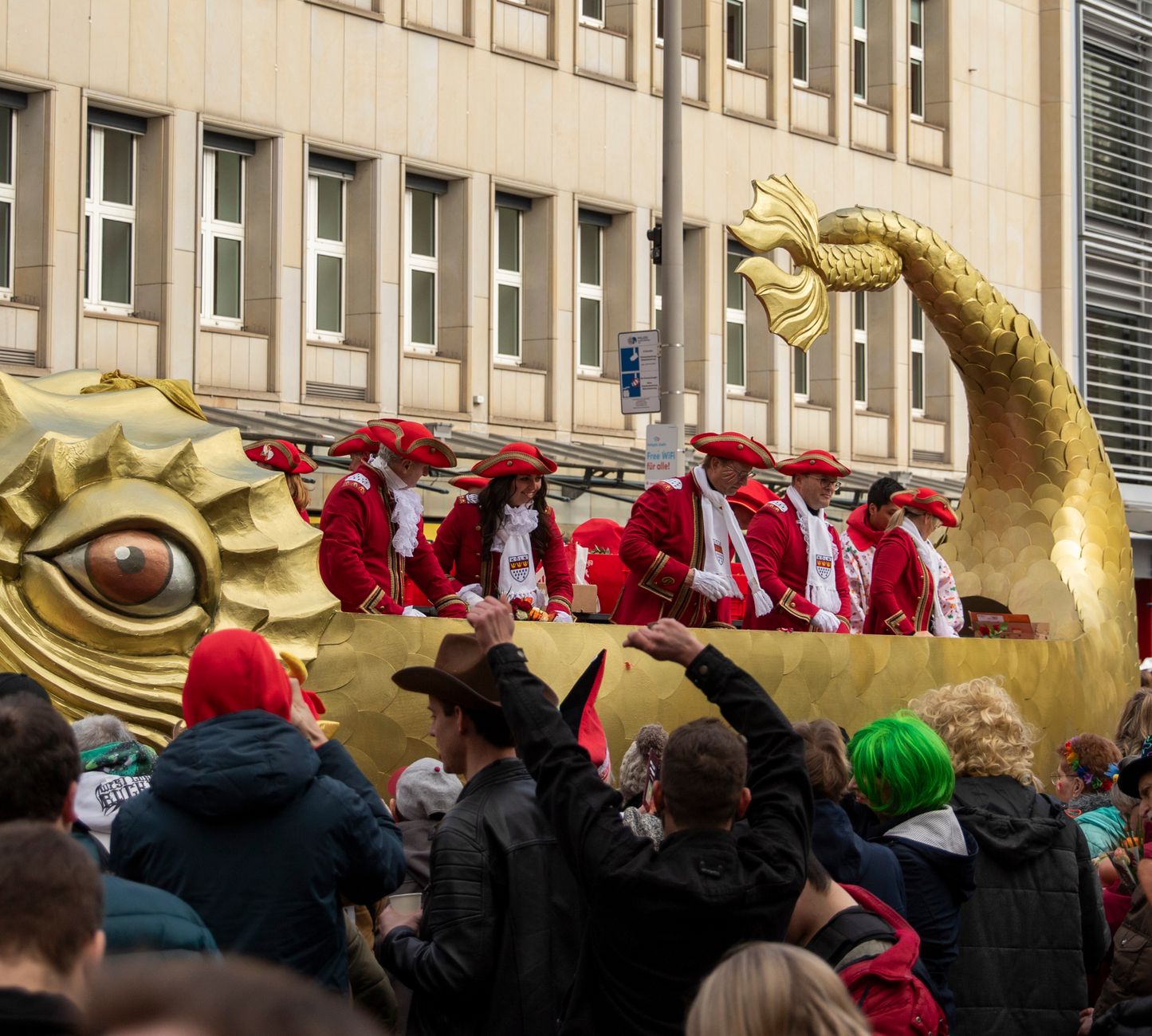
This is why people come. The Cologne Rosenmontag parade has been running since 1823 and is the largest carnival parade in Germany by spectator count. Around 1 million people line the route, which runs through central Cologne. The parade itself lasts six to seven hours, covering roughly 7km.
What you get: approximately 100+ floats, including the famous political satire floats; marching bands; costumed groups; dancers; and a continuous barrage of Kamelle — sweets, candy, chocolate, small toys, and confetti thrown from floats into the crowd. Spectators catch and collect the sweets, which is part of the experience. Bring a bag.
This is what you came for. Plan around it.
Fastelovend Dienstag — Tuesday (The End)
The final day is quieter — many people are exhausted, and the intensity has dropped. There are still celebrations, but it's the unwinding phase. Many restaurants offer the traditional Herringsessen — herring dishes, marking the Catholic Lenten tradition beginning the next day.
Advertisement
Ash Wednesday — The Aftermath
Cologne has a remarkable capacity to clean itself up. The city deploys its full street-cleaning operation and the transformation from carnivalchaos to normal city is visible within hours. If you're arriving on Ash Wednesday, you'd barely know what just happened. The city returns to itself with striking efficiency.
The Rosenmontag Parade — How to Watch

The Route
The parade follows a set route through central Cologne, starting near Severinstor in the south, running north through the Altstadt, and finishing near the Cathedral area. The full route is published officially by Cologne tourism closer to the date.
Best Spots
Neumarkt is one of the most popular viewing areas — wide plaza, good sightlines, food and drink vendors nearby. Expect it to be packed.
Zülpicher Straße runs through the student quarter and has strong local Karneval culture. The atmosphere here tends to be younger and more festive than the family-oriented sections.
Advertisement
Rudolfplatz is another good-atmosphere spot — the historic gate provides a backdrop and there's typically a strong street-party feel in the streets feeding off it.
Practical Parade Advice
Get there early. For a decent spot on Rosenmontag, you want to be in position by 8am. The parade typically starts around 10am and the good spots fill long before that. Arriving at 9:30am and expecting a front-row view is optimistic.
Dress warm. March 1 in Cologne is winter. It will likely be cold and possibly wet. Carnival costumes are not designed for warmth — wear layers underneath, bring waterproofs if your costume allows, and accept that your feet will be cold by hour three.
Bring a bag for Kamelle. The sweets thrown from floats are genuinely abundant. A tote bag or backpack works fine. Don't try to be sophisticated about this — everyone is catching Kamelle.
Take photos early, then put the phone down. The parade is long enough that you'll have plenty of opportunity to photograph floats. Once you've got your shots, actually watching and experiencing the parade is better than viewing it through a screen for six hours.
What to Wear
A costume is not optional. This is the thing most visitors underestimate. If you arrive in Cologne on Rosenmontag in normal clothes, you will feel conspicuously out of place — not because anyone will say anything, but because literally everyone around you is in costume. The city transforms, and standing there in a regular jacket makes you a spectator rather than a participant in a way that feels limiting.
What works:
- Superhero costumes — perennially popular, easy to find
- Animal costumes — also everywhere
- Historical or period costumes
- Cologne or Rhineland-themed costumes (football shirts count, especially Cologne FC)
- Anything colourful and recognisable
Where to buy:
- Costume shops (Karnevalskostüm shops) flood Cologne from late January; the best selection is late January to mid-February
- Supermarkets (Rewe, Edeka) sell basic costumes from late January
- Amazon and online shops deliver from November
- Budget: €20-50 gets you a decent costume; spending more gets you a better-fitting one
What to avoid:
- Costumes that mock or caricature ethnicities
- Vintage military uniforms — specifically Third Reich period; these are inappropriate and illegal in Germany
- "Sexy" versions of traditional cultural dress from non-Western cultures
If you're coming from Frankfurt or another German city, buy your costume there rather than in Cologne during Karneval week — choice will be better and prices lower.
Practical Logistics
Accommodation
Book months in advance. This is not a suggestion — it's the single most important logistical fact about visiting Cologne Karneval. Hotels in Cologne sell out completely for Weiberfastnacht and Rosenmontag, and prices triple compared to normal. December accommodation in Cologne is cheap by comparison.
If you're visiting for just Rosenmontag, consider staying in Düsseldorf or Bonn and taking the train in for the day. These cities are 20-30 minutes from Cologne and will have more availability and lower prices. Alternatively, Frankfurt to Cologne is an hour by ICE — doable as a day trip if you accept a very early departure and late return.
Search Cologne hotels via Booking.com — book as early as possible once you've decided on dates.
Train Tickets
Cologne is on one of Europe's busiest rail corridors. Frankfurt to Cologne takes 55 minutes by ICE. Book Deutsche Bahn tickets immediately when the booking window opens — the 3-month advance window for February/March tickets opens in November. Karneval week is heavily booked by locals and visitors alike, and the cheap Sparpreis fares disappear within hours.
Book trains via Deutsche Bahn — set a calendar reminder for when the booking window opens.
Transport in Cologne During Karneval
Cologne runs extended tram and U-Bahn schedules during Karneval, including additional night services. The KVB (Cologne's public transport operator) publishes a specific Karneval transport schedule closer to the date.
During Rosenmontag, walking is often faster than transport within the central area — parts of the route are closed to traffic, and stations get extremely crowded. Plan walking routes between your accommodation and viewing spots rather than relying on trams.
Food and Drink
Kölsch is the drink of Karneval. Cologne's local beer is served everywhere — in Brauhäuser, from temporary outdoor bars, from street vendors. The standard measure is a Stange (tall, narrow 200ml glass). Waiters in traditional Brauhäuser (called Köbes) keep bringing full glasses and marking your coaster until you put a coaster on top of your glass to signal you're done. This system works fine until you're mid-carnival and lose track.
Traditional Karneval foods: Reibekuchen (potato pancakes with apple sauce) are sold at market stalls throughout. Muzen (small fried pastries, similar to doughnuts without filling) are a specifically Karneval food. Berliner (jam doughnuts) are also everywhere. Food prices rise modestly during Karneval — not dramatically, but noticeably at tourist-facing venues.
The major Brauhäuser (Früh am Dom, Gaffel am Dom, Päffgen) will have long waits. Go early or accept the queue as part of the experience.
Safety and Crowds
Cologne Karneval is generally a good-natured event. The crowd behaviour is celebratory rather than aggressive, and serious incidents are rare relative to the number of people involved. Normal city-sense applies: keep your phone and valuables secure in a bag rather than a pocket, be aware of your surroundings in very dense crowds, and know where the exits are if you're in a tight street space.
Visiting with Young Children
Honestly: Weiberfastnacht and Rosenmontag are not suited to babies or toddlers. The combination of extreme crowds, sustained noise, early-morning alcohol consumption, and unpredictable street conditions makes the central celebrations unsuitable for small children. If you have young children and want to experience Karneval, the Karnevalssonntag neighbourhood parades (schools and communities parade) are a much better option — family-oriented, less intense, with more space.
Don't let this stop you visiting Cologne in general — the city is very good with young children. But the main Karneval days are genuinely not compatible with babies or toddlers. See the full Cologne with kids guide for what works year-round.

Is Cologne Karneval Worth Visiting?
Yes, if: You like large, chaotic, culturally specific festivals. You're prepared to commit — costume, early arrival, the full Rosenmontag experience. You enjoy being part of something that a city takes genuinely seriously, not performed for tourists. You can handle crowds and noise and cold for extended periods.
No, if: You prefer calm cultural tourism. You're visiting Cologne primarily for the Cathedral, the museums, the food scene, and the Rhine walks — Karneval is not the context for any of those. You have very young children. You're visiting Germany in February and assumed Karneval would be a convenient add-on — it's not an add-on, it's a full commitment.
The mistake some visitors make is arriving for Karneval without the costume, standing at the side of the parade in their normal clothes, and feeling disconnected from something they're watching rather than participating in. If you're going, go all in. Get the costume sorted in advance, get your spot on Rosenmontag by 8am, learn "Kölle Alaaf", and commit to the day.
The other mistake is visiting Cologne specifically during Karneval week if you didn't plan for it. The city is at its least functional for normal tourism — Cathedral queues, museum opening hours disrupted, Altstadt restaurants overwhelmed. If you want to see Cologne as a city, come in a different week.
Cologne Outside of Karneval
Karneval shouldn't be the reason you avoid Cologne the rest of the year. Outside of February, Cologne is one of Germany's most enjoyable cities — the Cathedral, the chocolate museum on the Rhine, the Belgian Quarter neighbourhood, excellent Brauhäuser culture, and the Rhine promenade all work at any time of year.
The Cologne Christmas markets (six markets simultaneously, including the Cathedral market which is genuinely one of the best in Germany) run late November to 24 December. The rest of the year is equally good.
See the full guides: things to do in Cologne, Cologne travel guide, and Cologne as a day trip from Frankfurt.
Related: Things to Do in Cologne · Cologne Travel Guide · Cologne Christmas Markets · Cologne Day Trip from Frankfurt
Save More
Save 5% on activities
Use code CHASINGWHEREABOUTS5 in the GetYourGuide app.
Book this exact experience in GetYourGuide appGet Travel Tips in Your Inbox
Join 5,000+ travelers. Get exclusive itineraries, honest reviews, and budget hacks once a week.
No spam. Only high-quality travel advice. Unsubscribe anytime.