Disclosure: Chasing Whereabouts is reader-supported. This guide contains affiliate links to partners like Tiqets, GetYourGuide, Viator and Headout. If you make a purchase through these links, we may earn a small commission at no extra cost to you. This helps us continue providing free, first-hand travel guides. Thank you for your support!
Cologne and Düsseldorf are 45 kilometres apart and have been arguing about beer for roughly a century. Cologne drinks Kölsch — pale, light, served in a thin 200ml glass by a waiter who refills it before you've finished asking. Düsseldorf drinks Altbier — darker, more bitter, slightly mysterious, served with what the locals consider justified pride and what Cologne considers unnecessary attitude.
The two cities mock each other with an affection that verges on theatrical. Cologne people call Düsseldorf the city that wishes it were Cologne. Düsseldorf people consider that a compliment to both cities. Both cities are on the Rhine, both have a serious old town pub district, and both think they've got the better beer. The Kölsch-vs-Altbier debate is one of those regional arguments that, from the outside, looks like it's about beer but is really about identity, civic pride, and who gets the good football results.
This is all useful context for a day trip, because Düsseldorf is an excellent day trip from Cologne — and the rivalry makes it more interesting than it would be otherwise.
Disclosure: This post contains affiliate links. If you book through these links, I may earn a small commission at no extra cost to you.
The Cologne-Düsseldorf Rivalry (What You're Walking Into)
The beer rivalry is real, not manufactured for tourists. It maps onto a genuine historical tension between two cities of similar size, similar position on the Rhine, and overlapping commercial ambitions. Cologne was a free imperial city with a cathedral and a serious trading history. Düsseldorf was the seat of the Duchy of Berg and grew into a financial and fashion capital. Neither ever quite eclipsed the other.
Advertisement
The practical consequence for your day trip: when you sit down in a Düsseldorf Brauhaus and the Köbes (the waiter — same word, same role as in Cologne) asks what you want, you say Altbier. If you ask for Kölsch, you won't be refused, but you might get a raised eyebrow, a brief pause, and the particular silence of someone exercising professional restraint. It's worth trying Altbier on its own terms rather than as a comparison exercise. It's a genuinely different beer — amber to copper in colour, top-fermented, around 4.8% ABV, with a clean bitterness and more complexity than Kölsch's crispness. Different logic, different mood.
The automatic refill ritual is identical to Cologne: the Köbes will keep bringing fresh glasses and marking your coaster until you cover your glass to signal you're done.
Getting from Cologne to Düsseldorf
Cologne Hauptbahnhof to Düsseldorf Hauptbahnhof is one of the most frequent rail corridors in Germany. Regional trains (RE services) run every 20-30 minutes throughout the day and take 25-35 minutes depending on the service. ICE trains do it faster but aren't necessary — the RE is fine and fully covered by the Deutschlandticket.
| Route | Journey Time | Notes |
|---|---|---|
| Cologne Hbf → Düsseldorf Hbf (RE) | ~25-35 min | Every 20-30 minutes all day |
| Frankfurt Hbf → Düsseldorf Hbf (ICE) | ~60-75 min | Direct, check DB timetable |
| S-Bahn (slower option) | ~45 min | More stops; not worth it if RE is available |
If you have a Deutschlandticket: this journey is fully covered. Board any RE service from Cologne Hbf platform and go. The Deutschlandticket covers all regional trains in Germany including the full Cologne–Düsseldorf corridor.
Without Deutschlandticket: a single ticket costs around €10-15 depending on the service. Buy through the DB app or at the ticket machine at Cologne Hbf. The NRW-Ticket works too if you're travelling in a group of up to five.
Advertisement
Düsseldorf Hauptbahnhof is not immediately next to the sights — it's about 15 minutes on foot to the Altstadt, or a short tram ride. The Kö (Königsallee) is a 10-minute walk from the station.
How to Spend One Day in Düsseldorf
The core of Düsseldorf is compact enough to cover on foot. The Altstadt, Kö, Medienhafen, and Rhine promenade form a loose loop that works well as a walking route. Here's how to structure it.
Morning: Königsallee and Medienhafen
Start at the Königsallee — the Kö — which is close to the station and best in the morning before it gets busy. Walk the full length of the boulevard (about 800 metres) in one direction and come back on the other side.
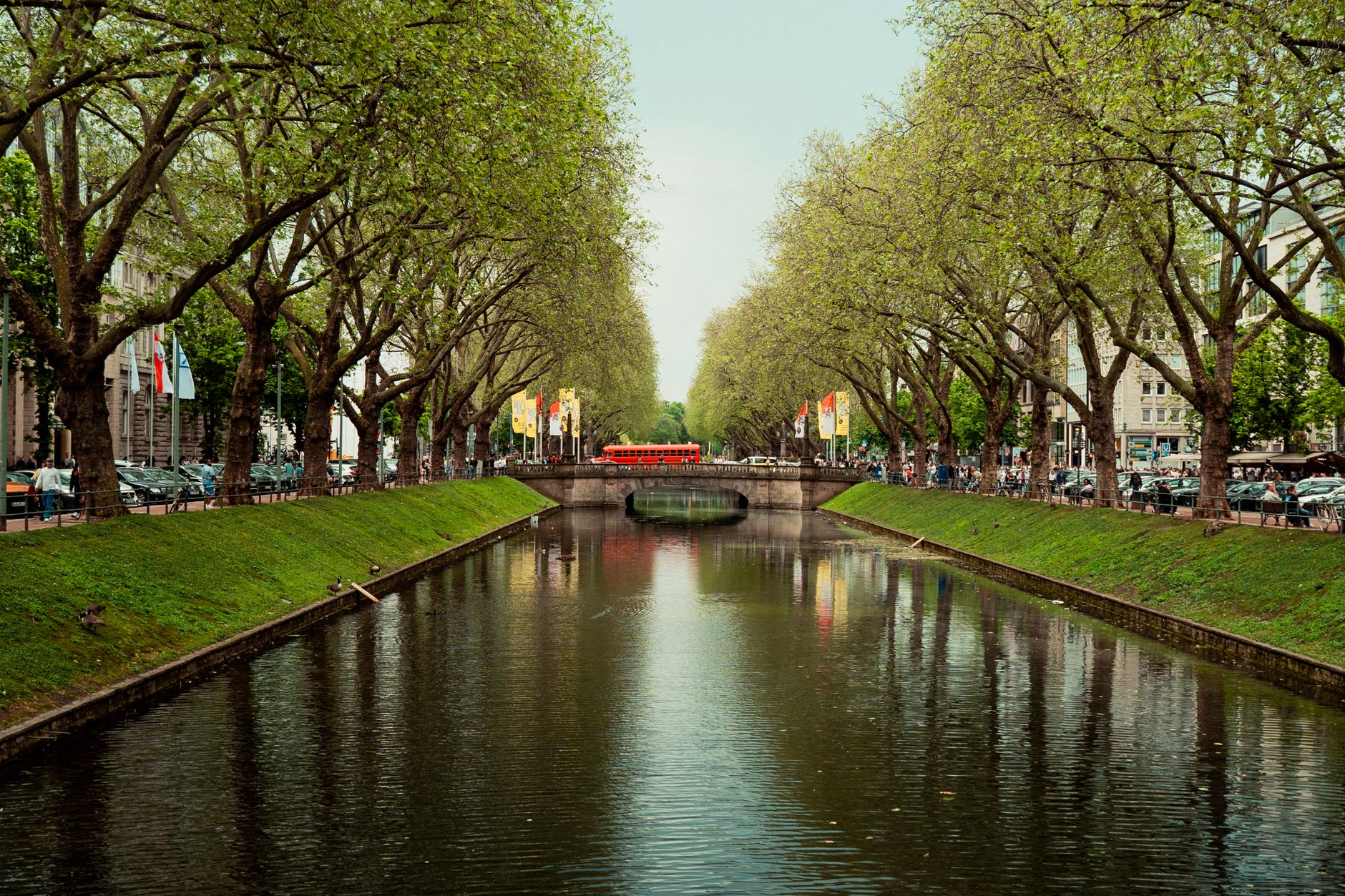
The Kö is one of Germany's famous luxury shopping streets: Hermès, Louis Vuitton, Bulgari, Chanel. What makes it visually distinctive is the tree-lined canal that runs down the middle of the boulevard, with footbridges crossing it at intervals. In summer the trees are fully green and the reflection in the water is genuinely beautiful. Even if you're not shopping — and at these prices, most people aren't — the boulevard is worth walking for the architecture and the canal alone. Free.
Advertisement
From the southern end of the Kö, head west toward the Medienhafen (Media Harbour). It's a 15-minute walk along the Rhine or through the city.
Medienhafen is Düsseldorf's former industrial harbour, converted into a media and creative district. The architectural centrepiece is the Neue Zollhof — three Frank Gehry buildings with deconstructivist, irregular facades that look deliberately wrong in the best possible way. They're among the more photographed buildings in NRW and they live up to the reputation. Walk around all three to see how they change from different angles.
The harbour itself has been sympathetically redeveloped with restaurants and offices along the water. It's worth 30-45 minutes for the walk and photos, and you can have a coffee here before heading to the Altstadt.
Midday: Altstadt and Altbier
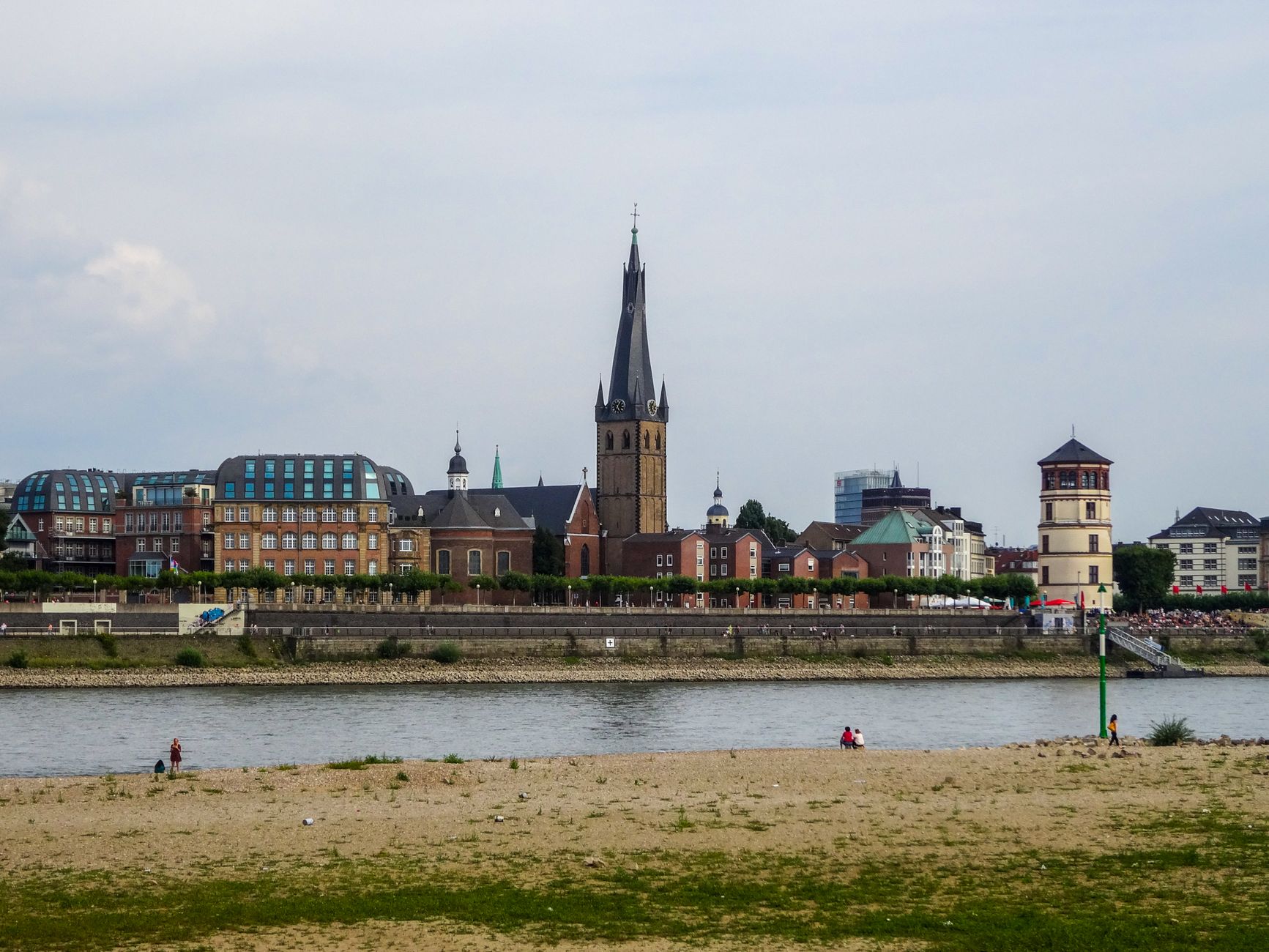
Walk from Medienhafen north along the Rhine promenade to the Altstadt. The Rhine promenade in Düsseldorf is wide and pleasant, with good views across the water. The Altstadt begins where the promenade gets busy — you'll know you've arrived when the pub density increases noticeably.
Advertisement
The Düsseldorf Altstadt is known as the longest bar in the world, which is hyperbolic but reflects something real: it's an exceptionally high concentration of bars, pubs, and Brauhäuser in a small area. On a weekday lunchtime it's lively but manageable. On a Friday or Saturday evening it's something else entirely.
For lunch and your first Altbier, aim for one of the traditional Brauhäuser:
- Uerige (Berger Straße 1) — the most famous, can be busy, dark interior, excellent Altbier, proper Düsseldorf atmosphere
- Füchschen (Ratinger Straße 28) — slightly less crowded than Uerige, traditional, good food alongside the beer
- Schumacher (Oststraße 123) — slightly outside the core Altstadt but respected and less tourist-focused
Sit down, order the Altbier, eat something solid (the traditional Düsseldorf Brauhäuser do good German food — Schweinshaxe, Sauerbraten, Rheinischer Sauerbraten), and let the Köbes do their thing. If the glass is empty, another appears. Cover it with the coaster when you're done.
Afternoon: Japanese Quarter and Second Altbier
After lunch, walk north-east from the Altstadt toward Immermannstraße. This is the edge of Düsseldorf's Japanese Quarter — the area around Immermannstraße and the streets leading off it contains what is, by most accounts, the largest Japanese community in continental Europe.
The density of Japanese businesses in this relatively small area is striking. Japanese supermarkets (Takara, Dae Yang) selling products you won't find outside Japan. Ramen restaurants, sushi bars, Japanese bakeries, a Japan Centre. If you want to pick up Japanese snacks, proper Japanese ramen ingredients, or just see something genuinely unexpected in a German city, this is it. An hour here is well spent and breaks the rhythm of the day nicely.
Advertisement
From the Japanese Quarter, wander back toward the Altstadt for a second Altbier before the train back. The Rhine promenade in the late afternoon, with the light changing, is worth taking slowly.
Trains back to Cologne run throughout the evening, so there's no hard stop.
Altbier — What You're Drinking and Where
Altbier is a top-fermented ale, which puts it in the same broad family as English ales and Belgian ales rather than the lager family that most German beers belong to. The name means "old beer" — a reference to the older method of top fermentation, predating the cold-fermented lagers that came to dominate Germany in the 19th century. Düsseldorf held on to the top-fermented style; Cologne did the same with Kölsch. The Rhine apparently contains strong opinions about fermentation.
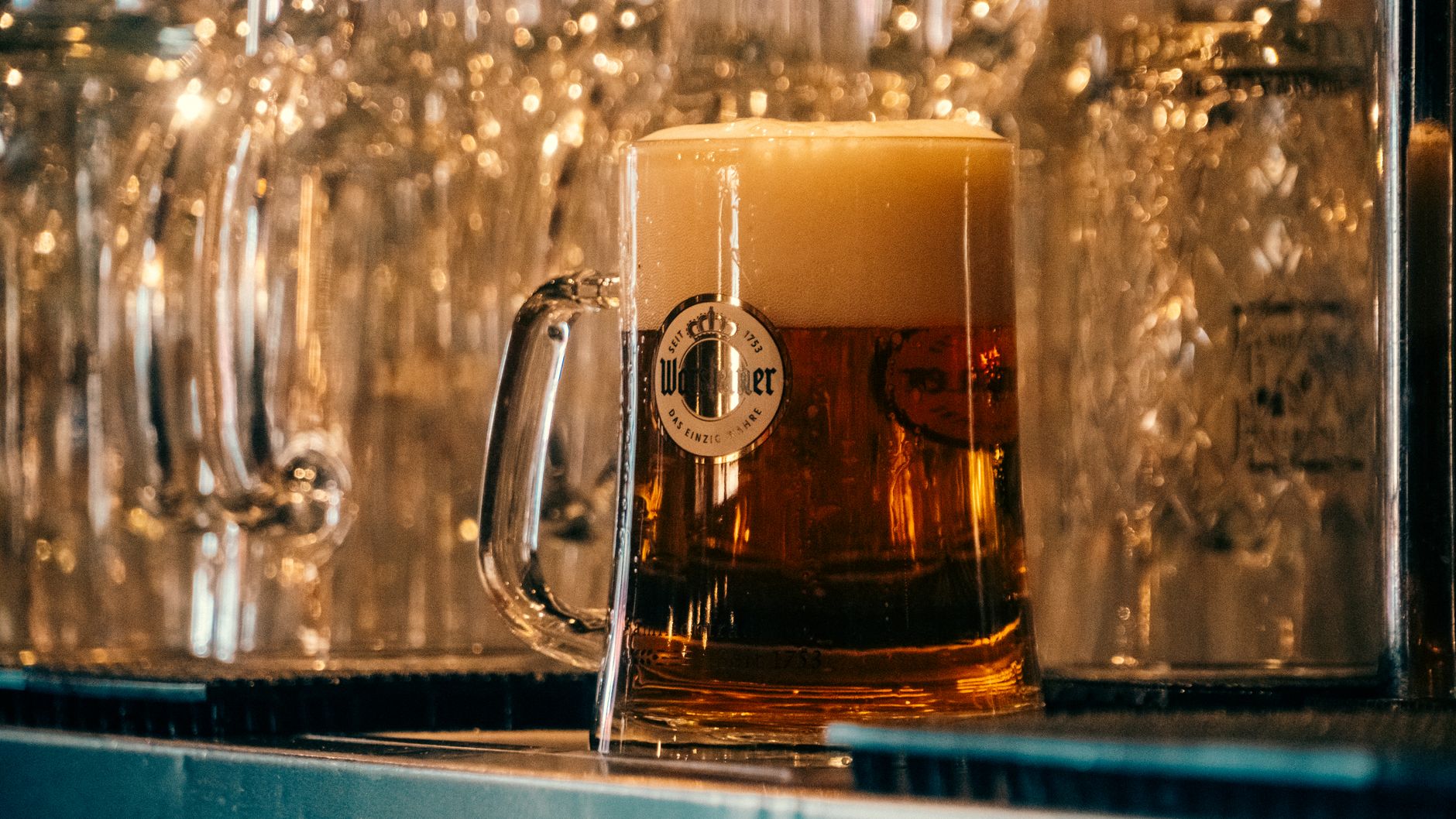
Colour: amber to copper. Bitterness: more pronounced than Kölsch, with a clean finish. Body: medium, not heavy. ABV: around 4.8%. Glass: 0.25 litres, slightly larger than the Kölsch Stange (0.2L).
The Brauhäuser that make and serve their own Altbier on-site:
- Uerige — probably the most respected; the Uerige Altbier has a slightly drier, more bitter character
- Füchschen — perhaps slightly more approachable; the food menu is good
- Schumacher — the oldest of the three surviving independent Altbier Brauhäuser, dating from 1838
If you're in a Brauhaus and you want to try something else after the Altbier, ask about Killepitsch — a sweet, intensely herbal liqueur that's a Düsseldorf speciality. It's the local digestif, sold in the distinctive bottle shaped like a bowling pin. You'll see it behind most bars in the Altstadt.
The Königsallee — A Longer Look
The Kö deserves more than a quick pass. It's about 800 metres long, divided down the middle by a canal (the Stadtgraben, part of the old city moat) with trees along both sides and footbridges connecting them. The western side (where you walk south) has the more expensive boutiques; the eastern side (walking north) has slightly more varied shops and the arcades.
The architecture along the Kö ranges from early 20th-century Wilhelminian buildings to postwar commercial architecture to contemporary renovations, with the result that it feels layered rather than uniform. The canal makes it more interesting to walk than a standard shopping street.
Even if your budget doesn't extend to what's on sale, the Kö is genuinely one of Germany's better urban boulevards — comparable to Munich's Maximilianstraße in prestige, but with the canal making it more distinctive visually.
Medienhafen — Düsseldorf's Architecture District
The Neue Zollhof buildings are the headliner, but the Medienhafen repays a longer walk. The redevelopment of the former harbour area started in the 1990s and brought in a range of architects — Gehry's three buildings are the most famous but there are interesting modern buildings throughout the district.
The harbour basin itself is well-maintained, with boats moored along the quayside and restaurants and bars facing the water. It's a pleasant area to walk through and has a different feel from the Altstadt — less traditional German pub culture, more creative-district energy. Worth at least 45 minutes.
Practical Tips
Weekday vs weekend: The Altstadt is significantly more crowded on Friday and Saturday evenings — this is one of Düsseldorf's main nightlife areas. If your priority is seeing the Brauhäuser in a relaxed way, a weekday works better. If you want to see Düsseldorf in full swing, a Saturday evening is the experience.
The Kö and shops: Most shops on the Königsallee open around 10am and close around 7-8pm. Museums keep shorter hours. The Altstadt bars are essentially open all day.
Getting around: Düsseldorf's centre is compact and walkable. The main loop — station → Kö → Medienhafen → Altstadt → Japanese Quarter — is around 5-7km total and can be done entirely on foot without rushing.
Tickets: The KölnPass (if you have one from Cologne) is not valid in Düsseldorf — different city, different transport zone. The Deutschlandticket covers the train between the cities but not necessarily the Düsseldorf trams (check current validity, as the Deutschlandticket rules for city transit within destination cities can vary by region).
Language: German is the operating language. English is understood in most tourist-facing contexts, and the Brauhäuser staff have handled enough confused tourists to be patient about it.
One Final Note
Düsseldorf and Cologne are genuinely different cities despite their proximity. Cologne has the cathedral, the Roman history, the sense of being slightly rumpled and down-to-earth. Düsseldorf is more polished, more fashion-conscious — it's one of Germany's fashion and advertising capitals — with the Kö and the Medienhafen reflecting that energy. The Altstadt is the place where Düsseldorf lets its hair down and becomes something closer to what Cologne is day-to-day.
Both cities are better for knowing the other exists. Spend a day in each. Order the local beer in each. The rivalry gives you something to think about on the train home.
Related: Things to Do in Cologne · Best Kölsch Breweries in Cologne · Bonn Day Trip from Cologne
Save More
Save 5% on activities
Use code CHASINGWHEREABOUTS5 in the GetYourGuide app.
Book this exact experience in GetYourGuide appGet Travel Tips in Your Inbox
Join 5,000+ travelers. Get exclusive itineraries, honest reviews, and budget hacks once a week.
No spam. Only high-quality travel advice. Unsubscribe anytime.