
Disclosure: Chasing Whereabouts is reader-supported. This guide contains affiliate links to partners like Tiqets, GetYourGuide, Viator and Headout. If you make a purchase through these links, we may earn a small commission at no extra cost to you. This helps us continue providing free, first-hand travel guides. Thank you for your support!
🇪🇺 This guide is part of our comprehensive Europe Travel Guide.
As a travel blogger, I get the temptation: a drone can turn a normal viewpoint into a shot people remember. But flying drones in Europe is not as simple as packing list generator the drone and finding a pretty viewpoint.
This guide explains the paperwork, operator registration, pilot certificates, EASA open-category rules, and the extra country checks you should make before flying.
Before You Fly: Get Your EU Drone License
If your trip includes the EU or an EASA-associated country, sort your drone paperwork before you pack the batteries. For most drones from 250 g, the A1/A3 certificate is the baseline remote pilot proof; A2 may be needed for some heavier open-category flights closer to people. EASA's open-category guidance explains the A1, A2, and A3 operating subcategories, and the national aviation authority still controls registration, maps, insurance, and local restrictions.
Advertisement
Start the online EU drone license training with DroneLicense.eu
Affiliate disclosure: this is our partner link. DroneLicense.eu can help with EU drone training and exams, but always check the official EASA open-category rules and the national aviation authority for your destination before you fly.
One Operator Registration for EASA Member States
Once in your home nation or primary place of business, you must register as a drone operator. You will be given a special drone operator registration ID that can be used on your drone(s) in all EASA Member States.
You only need to make sure that your operator registration ID, issued in your country of residence or place of work, is clearly visible on your drone(s) if you are transporting them to another EASA Member State.
Drone pilot certificate validity across EASA Member States
All drone pilot certificates granted by any EASA Member State will be accepted in all other EASA Member State nations under the new European Drone Regulation. Pilot certificates are not issued by EASA itself.
Advertisement
Therefore, if you obtained a remote pilot competency certificate in one EASA Member State, took the required online training, and passed the drone pilot exam, you are authorized to fly a drone in any other EASA Member State.
Travelling outside Europe with your drone
You must abide by local drone operating and flying laws if you take your drone anyplace outside of the EASA Member States.
The majority of the general aspects (registration, ID number, pilot training and exam, pilot certificate, where to fly or not to fly, etc.) will be conceptually very similar to those in place in EASA Member States in countries with well-regulated drone systems.
However, national aviation authorities in EASA Member States do not immediately recognize drone operators IDs and pilot certifications in non-EASA Member States.
To find out what to do, get in touch with the aviation authorities of the states you intend to visit. For example, when I was planning drone shots near Dubrovnik, I had to check Croatia-specific drone rules rather than relying only on general Europe guidance.
Advertisement
Non-EU residents visiting Europe
You must register as a drone operator with the National Aviation Authority of the first EASA state you intend to operate from if you are a resident of a non-EASA Member State and intend to travel to and use a drone in an EASA Member State.
This is valid once you have registered in the host EASA Member State and throughout the other EASA Member States. No further registration with another EASA Member State is required.
Additionally, you must complete training, pass an online exam for a drone pilot's license, and obtain a European certificate in any EASA Member State. The training and test are offered in English by some National Aviation Authorities.
Of course, you also have to abide by European Drone Laws.
To prepare for your trip, please take time to review all information on drones published on Civil Drones and check the list of EASA Member States’ ‘Naa’.
General Rules for Flying a Drone in the European Union
Under the new regulations, there are three operational categories that determine drone regulations based on the weight of the drone and the intended operation.
Advertisement
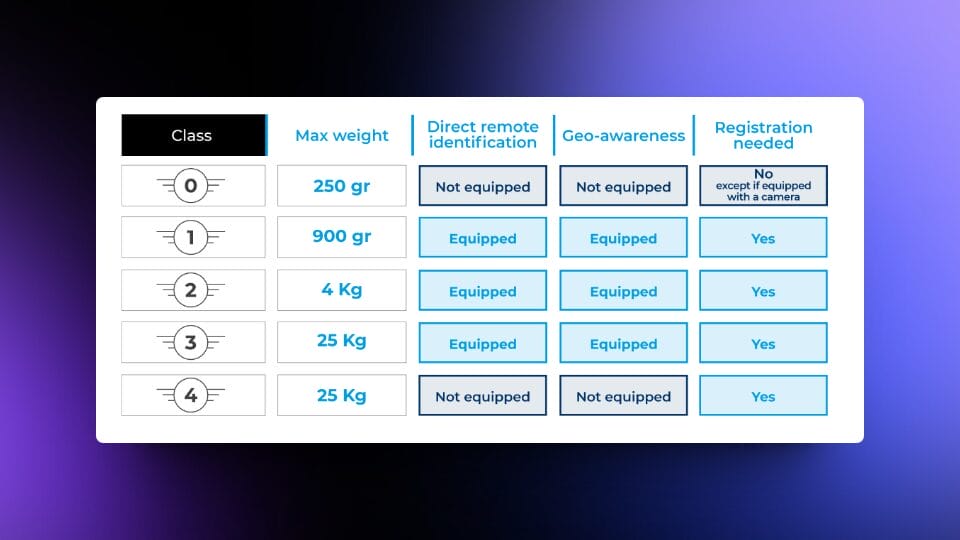
Open Category
A drone can be operated in the “Open “category if:
-
One of the class identification labels for the drone is 0, 1, 2, 3, or 4.
-
The drone was purchased prior to January 1, 2026, and it lacks the aforementioned class identification label.
-
The maximum takeoff mass of the drone is less than 25 kg (55 lbs).
Advertisement
-
The drone is kept safely away from people by the remote pilot.
-
Unless the drone carries a class identification label or weighs less than 250 g, it cannot be flown directly over humans (0.55 lbs). (To learn where you can fly your drone, please see the subcategories of operations: A1, A2, and A3)
-
A UA observer will aid the remote pilot if necessary to preserve visual line of sight (VLOS).
-
The remote pilot won't fly the drone higher than 120 meters (400ft).
-
The drone won't drop any materials or transport any hazardous cargo.
What Happens if Your Drone Does Not Have a Class Marking?
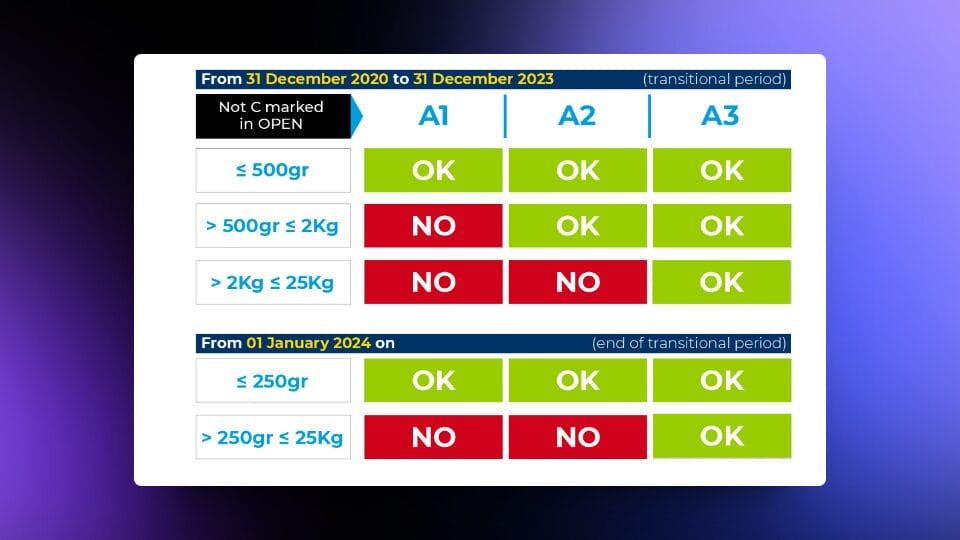
Since this rule about the Classes and Category came when the EASA announced these changes and for example I have my drone before that time my drone doesn't have the class marking on it.
So what I need to be aware of is that in which class my drone falls and follow the rule according to that.
You have to check the same as per the image which I have shared before and identify
For older drones without a class label, check the current EASA open-category guidance before flying. As a conservative starting point:
-
Less than or Equal to 250gm should be flown in Open A1
-
More than 250 gm should be flown as OPEN A3.
-
Do not assume A2 is available for an older unmarked drone unless the current EASA rules say your exact setup qualifies.
Do you need Liability Insurance?
The answer is yes, normally there are some countries which allows you to fly drone without liability insurance for Mavic Mini but in general you need that.
You can get more information about that Naa.
What to do when there is an accident?
Well, you have to inform about the accident to the authorities. There is an incident reporting system for informing about the accident be it of any type
If you are flying in the open category you have to report in case of any situation mentioned below
-
Fatal Injury to a person
-
Serious injury causing burns, broken bones, hospitalization.
-
When you get into an incident with manner aircraft.
You can report by using the link Aviationreporting
What is Visual Line of Sight?
Drone flying in open category should be carried out in VLOS which means visual line of sight.
So you have to make sure that you are able to watch your drone when you are flying so that you can avoid the accident.
Some special scenario where operations are also considered as VLOS are
-
the Follow me mode of the drone where the distance in between the pilot and the drone is less than 50m.
-
FPV mode with googles and the pilot is assisted with visual observer.
Am I allowed to fly over people?
Generally you are not allowed but there are exceptions
Exceptions in OPEN A1 are limited:
-
Drones falling under C0 category or weighing less than 250 grams can fly over isolated individuals, but with great care.
-
For drones classified as C1, flying over people should generally be avoided. In case of accidental overflight, minimize the duration as much as possible.
-
When uncertain or unclear about regulations, refrain from flying over individuals to avoid engaging in reckless behavior, which is against the law.
FAQ: Flying Drones in Europe
Do I need a drone license in Europe?
For many drones from 250 g, you should expect to need A1/A3 proof. A2 can be needed for some heavier open-category flights closer to people.
Does one EU registration work across Europe?
Operator registration from one EASA member state is generally recognized across EASA member states, but you still need to follow each country's local maps, insurance, privacy, and restricted-zone rules.
What should non-EU visitors do first?
EASA says non-EU operators should register with the national aviation authority of the first EASA country where they intend to operate. Start with EASA's national aviation authority directory.
Save More
Save 5% on activities
Use code CHASINGWHEREABOUTS5 in the GetYourGuide app.
Book this exact experience in GetYourGuide appGet Travel Tips in Your Inbox
Join 5,000+ travelers. Get exclusive itineraries, honest reviews, and budget hacks once a week.
No spam. Only high-quality travel advice. Unsubscribe anytime.