Disclosure: Chasing Whereabouts is reader-supported. This guide contains affiliate links to partners like Tiqets, GetYourGuide, Viator and Headout. If you make a purchase through these links, we may earn a small commission at no extra cost to you. This helps us continue providing free, first-hand travel guides. Thank you for your support!
🇪🇺 This guide is part of our comprehensive Europe Travel Guide.
Most people treat Strasbourg as a quick stop on the way to Paris or Frankfurt. That's a mistake. This is a city that has been French, German, French again, and German again — and it absorbed something from each era. The result is Alsatian: half-timbered houses that look Bavarian, wine that's unmistakably French, a cathedral that took 300 years to finish, and a food culture that can't decide if it wants sauerkraut or foie gras (it wants both).
I'm based in Frankfurt. Strasbourg is two hours by direct IC train. I've done it for a long weekend trip planner, for the Christmas market, and once just for a single afternoon. Here's what's actually worth your time.
| Attraction | Area | Cost (EUR) | Time needed |
|---|---|---|---|
| Strasbourg Cathedral | Grande Île | Free entry / €3 clock / €5–8 tower | 1–2 hrs |
| La Petite France | Centre | Free | 45 min–1 hr |
| Barrage Vauban rooftop | La Petite France | Free | 20 min |
| Palais Rohan (3 museums) | Grande Île | €7 each / €14 combined | 1.5–2 hrs |
| European Parliament | Neustadt | Free (book ahead) | 1.5 hrs |
| Alsatian Museum | Quai Saint-Nicolas | €7 | 1 hr |
| Christmas Market | City-wide | Free entry / vin chaud €3–4 | Half day |
| Colmar day trip | 30 min by TER | €7–10 train | Full day |
Strasbourg Cathedral
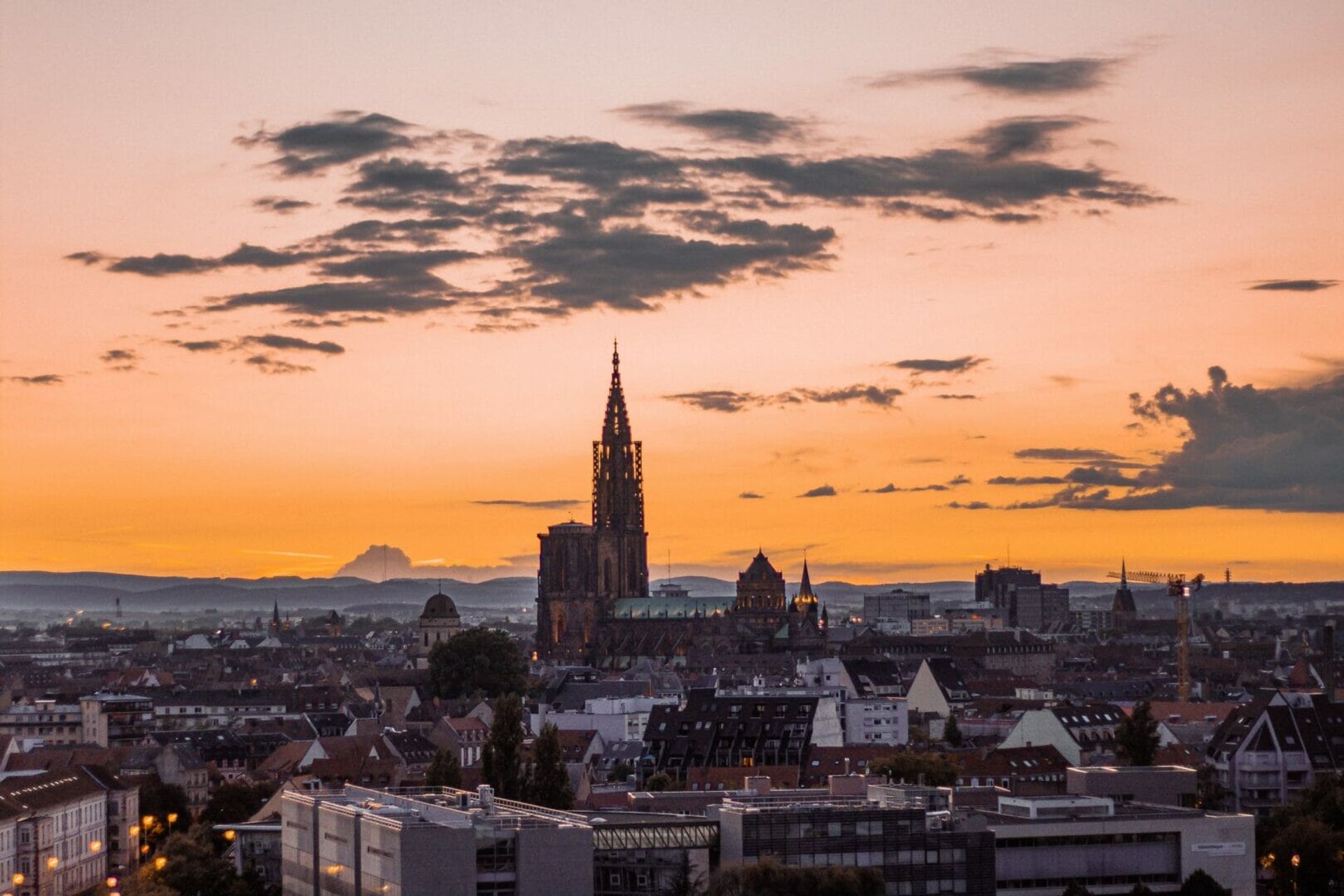
The Notre-Dame de Strasbourg is the defining sight of the old town. Construction started in 1176 and finished in 1439 — the spire was the tallest building in the world for 200 years. Entry to the nave is free.
Advertisement
Two paid experiences worth the money:
Astronomical clock show (€3): Runs at 12:30pm daily. Automata parade around the dial — apostles, a crowing rooster, the figure of Death. Queue starts forming by 11:45am. It's genuinely impressive, not a tourist gimmick.
Tower climb (€5–8): 332 steps to the viewing platform. Best views across the Alsace plain and down into La Petite France. Worth it if you're reasonably fit and the weather is clear.
The cathedral also has one of the great rose windows in Gothic architecture — look at it from the nave in the morning when the light comes through from the east.
La Petite France
The most-photographed quarter in Strasbourg: half-timbered houses reflected in the Ill River canals, flowers on every windowsill, cobblestones. It was a tanning district in the Middle Ages — the canal access was for soaking hides, not aesthetics. Now it's the centre of Strasbourg travel photography.
Advertisement
Go before 9am. By 10am the tour groups arrive and the alleyways get crowded. Before breakfast it's quiet, golden, and you get the canal reflections without a crowd of people in your shots.
Walk to the Ponts Couverts — three medieval towers connected by bridges over the Ill River. Then cross to the Barrage Vauban.
Barrage Vauban
The 17th-century dam built by the military engineer Vauban to regulate river levels and defend the city. The inside has a small exhibit on Strasbourg's waterway history — fine, nothing spectacular.
The rooftop terrace is free and the best viewpoint in Strasbourg. You look directly across the Ill to the Ponts Couverts and La Petite France with the cathedral spire behind. This is the shot. Don't skip it.
Palais Rohan and Its Three Museums
The Palais Rohan is an 18th-century Baroque bishop's palace a few steps from the cathedral. It houses three separate museums:
Advertisement
- Museum of Decorative Arts — furnished rooms from the 18th century, the original bishop's apartments intact. The dining room alone is worth the entry.
- Museum of Fine Arts — European painting from Giotto through 19th century. Botticelli, Goya, El Greco.
- Archaeological Museum — Roman-era Strasbourg (Argentoratum), prehistoric Alsace.
Each museum is €7 individually, €14 for a combined ticket. If you pick one, pick Decorative Arts — the Rohan family had good taste and no travel budget calculator constraints.
European Parliament
Strasbourg is one of three official seats of the European Parliament (alongside Brussels and Luxembourg). The building is in the Neustadt district, about 20 minutes walk from La Petite France.
Free guided tours run when Parliament isn't in session. Book through europarl.europa.eu — slots fill up weeks ahead for popular dates. You get a full walk-through of the chamber. Even if you're not particularly interested in EU politics, the scale of the hemicycle is striking and the tour covers Strasbourg's complicated Franco-German history well.
If you can't book in advance, at minimum walk around the exterior of the building — the glass architecture is impressive from outside.
Alsatian Museum
The museum most tourists skip and shouldn't. Located on Quai Saint-Nicolas, it occupies three connected Renaissance houses and walks you through traditional Alsatian life: regional costumes, furniture, religious objects, a reconstructed interior from an 18th-century Alsatian farmhouse. Entry €7.
Advertisement
This is where the Franco-German cultural hybrid makes most sense. The Alsatian dialect, the food, the architecture — they're not French with a German accent or German with French manners. They're their own thing. The museum explains why.
Christmas Market in Strasbourg
The Strasbourg Christmas market has been running since 1570 — the oldest in France and one of the oldest in Europe. It's called the Christkindelsmärik. It spreads across place Broglie, place de la Cathédrale, and several other squares in the old town.
Best time to go: mid-week, early evening. The market gets very crowded on weekends, especially the first and last weekends. A Tuesday or Wednesday in the second or third week of December is the sweet spot.
What to eat and drink:
- Vin chaud (mulled wine) €3–4 — Alsatian rather than German style, lighter and more aromatic
- Bredele (Alsatian shortbread cookies) — sold by the box
- Roasted chestnuts everywhere
The market runs late November through December 24. If you're visiting for the Christmas market specifically, book accommodation 2–3 months ahead — the city fills up entirely.
Advertisement
What to Eat in Strasbourg
Alsatian food is hearty, specific, and nothing like what you get in Paris.
Flammekueche (Tarte Flambée) — thin, crisp flatbread with crème fraîche, onion, and lardons. Nothing else. About €10–13. The best ones come out of a wood-fired oven in 3–4 minutes. Order two; one is never enough.
Choucroute garnie — sauerkraut braised in Riesling with smoked pork, various sausages, and potatoes. A proper portion is enormous. About €14–18. It's a winter dish but you'll find it year-round in Strasbourg. Don't order it on a hot August day and expect to do anything afterwards.
Baeckeoffe — a slow-cooked casserole of three meats (pork, beef, lamb) marinated in Alsatian wine overnight and cooked in a sealed terrine. Not every restaurant does it daily. About €16–20 when it's on. Ask if they make it in-house.
For wine: Riesling, Gewurztraminer, Pinot Blanc. All Alsatian, all distinct from German wines despite the same grape varieties. Skip the Bordeaux.
Day Trip: Colmar
If you have a second day, take the TER train to Colmar. 30 minutes, €7–10 return. Colmar is to La Petite France what La Petite France is to the rest of Strasbourg — a more concentrated, better-preserved version of the Alsatian canal-and-half-timber aesthetic. The old town is genuinely beautiful and significantly less crowded than Strasbourg.
The Unterlinden Museum in Colmar has the Isenheim Altarpiece — one of the most significant Northern Renaissance paintings in existence. Worth the detour alone.
Day Trip: Alsace Wine Route
Rent a car or join a group tour from Strasbourg and drive south on the D1083. The Alsace Wine Route runs through Ribeauvillé, Riquewihr, Kaysersberg, and a dozen smaller villages. Riquewihr is the most touristed but also the most intact — walls, towers, vines running right to the edge of the village. Go on a weekday in shoulder season.
Getting to Strasbourg
From Frankfurt: Direct IC/ICE trains, about 2 hours. Tickets from €25–45 depending on booking window. Book on Deutsche Bahn or SNCF.
From Paris: TGV from Gare de l'Est, about 2 hours 15 minutes. From €29 booked ahead.
Within Strasbourg: The tram network covers everything useful. A single ride is €1.80, a day pass is €4.70. The old town and La Petite France are walkable from each other — about 15 minutes on foot.
FAQ
What to not miss in Strasbourg?
Strasbourg Cathedral (especially the astronomical clock at 12:30pm), La Petite France before 9am, and the Barrage Vauban rooftop for the best view of the city. If you have extra time, Palais Rohan is the best museum in the city.
What is the signature dish of Strasbourg?
Flammekueche (tarte flambée) — thin flatbread with crème fraîche, onion, and lardons. It's the dish most specific to Alsace and the one that holds up best across different restaurants. Choucroute garnie is more filling and more famous but harder to do well outside of dedicated brasseries.
What is Strasbourg, France best known for?
Three things: the Strasbourg Cathedral (Gothic masterpiece, 11th tallest church in the world), La Petite France (canal district with half-timbered houses), and the Christmas market — running since 1570, the oldest in France. The European Parliament is also here, making Strasbourg one of the EU's capital cities.
What to do in Strasbourg for a day?
One full day: Cathedral in the morning (astronomical clock at 12:30pm sharp, tower climb if clear), La Petite France before or after lunch, Barrage Vauban rooftop (free, 10 minutes from La Petite France), afternoon in Palais Rohan or the Alsatian Museum. Dinner: flammekueche or choucroute at a proper Alsatian winstub.
Is Strasbourg worth visiting?
Yes. It's one of the most underrated cities in France — not because it lacks attractions, but because it sits between Paris and Germany and gets treated as a transit stop. The Franco-German cultural synthesis it embodies is unique in Europe. Two days is the right amount of time.
How many days in Strasbourg?
One day covers the highlights (cathedral, La Petite France, Barrage Vauban). Two days adds Palais Rohan, the Alsatian Museum, the European Parliament tour, and a leisurely dinner. A third day makes sense only if you use it for a day trip to Colmar or the Alsace wine route villages.
Is Strasbourg destination safety index for tourists?
Yes, generally safe. The usual urban precautions apply — watch for pickpockets around the Christmas market and the cathedral, especially when it's crowded. The old town is well-lit and busy until late.
What language do people speak in Strasbourg?
French officially, with some elderly residents still speaking Alsatian (a Germanic dialect). English is widely spoken in tourist areas, hotels, and restaurants.
City Passes — Where to Book
Save on attraction entry with official city passes, booked through Tiqets (instant e-ticket):
- Paris: Book on Tiqets → · Full review →
- Brussels: Book on Tiqets → · Full review →
Best Tours & Experiences
For guided tours and experiences, I recommend checking Viator — they have a huge selection with free cancellation on most bookings. You can also browse TripAdvisor Experiences for more local tours, day trips, and attraction tickets with real traveller reviews.
Save More
Save 5% on activities
Use code CHASINGWHEREABOUTS5 in the GetYourGuide app.
Book this exact experience in GetYourGuide appGet Travel Tips in Your Inbox
Join 5,000+ travelers. Get exclusive itineraries, honest reviews, and budget hacks once a week.
No spam. Only high-quality travel advice. Unsubscribe anytime.