Disclosure: Chasing Whereabouts is reader-supported. This guide contains affiliate links to partners like Tiqets, GetYourGuide, Viator and Headout. If you make a purchase through these links, we may earn a small commission at no extra cost to you. This helps us continue providing free, first-hand travel guides. Thank you for your support!
🇨🇿 This guide is part of our Europe Travel Guide. Updated March 2026 based on four personal trips to Prague.
Does Prague Use Euros? (Quick Answer)
No — Prague does not officially use Euros.
So if you are wondering is Prague on the Euro, the answer is also no. Prague is in the European Union, but the Czech republic is not in the Eurozone. The official currency is still the Czech Koruna.
The currency of Prague and the entire Czech republic is the Czech Koruna (CZK), sometimes called "crowns." Euros are not legal tender here, and while a handful of tourist-facing businesses accept them, you will almost always get a worse deal than paying in CZK or by card.
Advertisement
| Official currency | Czech Koruna (CZK / Kč) |
| Euros accepted? | Occasionally, at poor exchange rates |
| Best payment method | Card (Visa/Mastercard) or CZK cash |
| Approximate rate (2026) | ~25 CZK per €1 — check Wise for live rates |
| Euro adoption planned? | No confirmed timeline |
My personal rule after four Prague trips: bring your card, withdraw CZK from a bank ATM on arrival, and forget the Euros.
What Currency Does the Czech Republic Use?
The Czech Republic uses the Czech Koruna, ISO code CZK, symbol Kč. The word koruna means "crown" in Czech — the same root as the Danish krone and Swedish krona.
Coins and Banknotes
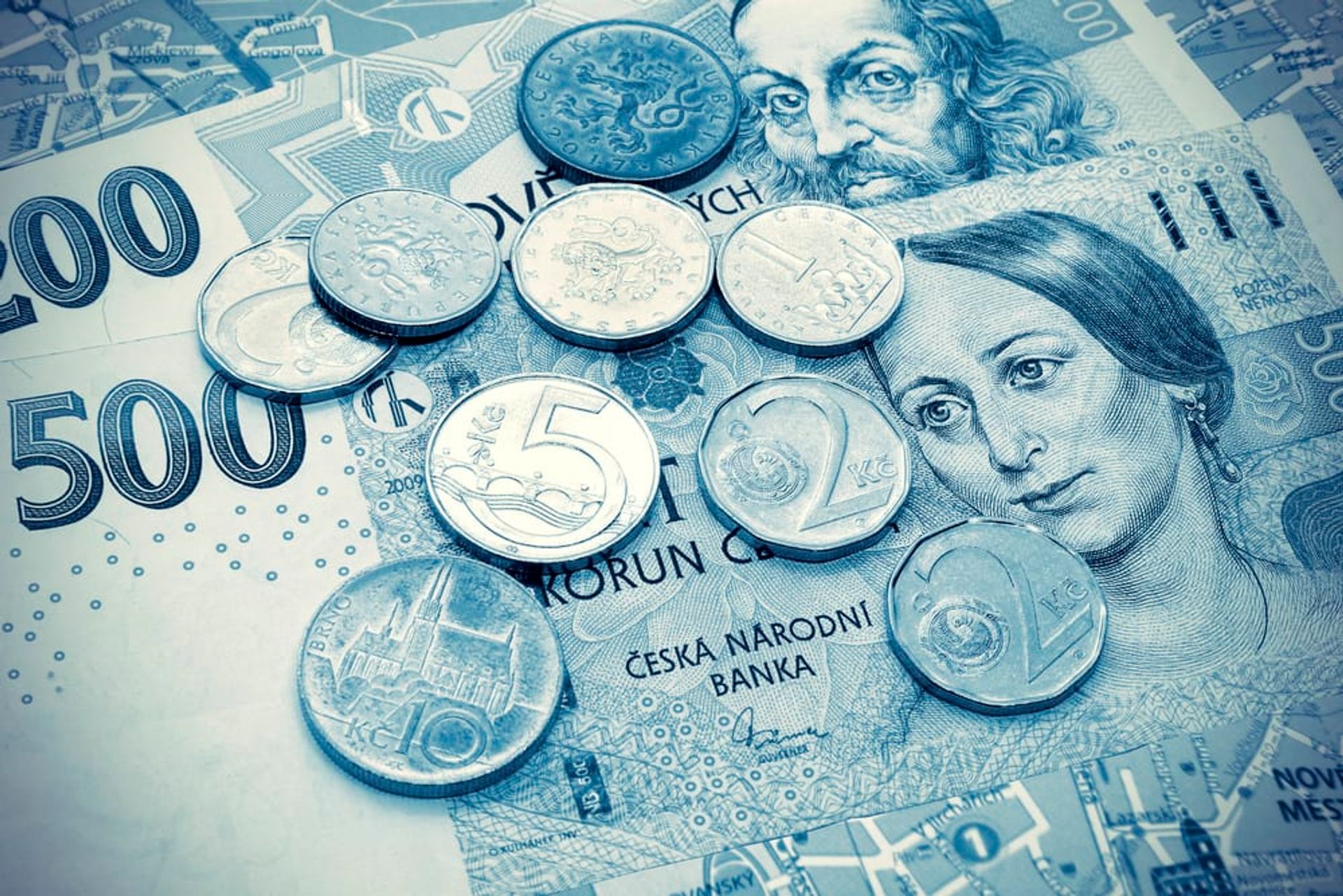
Coins: 1, 2, 5, 10, 20, and 50 CZK
Banknotes: 100, 200, 500, 1,000, 2,000, and 5,000 CZK
The smaller haler (heller) coins were withdrawn from circulation years ago, so prices are rounded to whole korunas.
Will the Czech Republic Join the Eurozone?
The Czech Republic is technically obligated to adopt the Euro as an EU member, but has not set a target date. The Czech National Bank regularly pushes back the timeline, citing inflation targets and public opinion. As of early 2026, there is no credible short-term prospect of Euro adoption. Plan your trip around CZK.
Advertisement
Can You Use Euros in Prague?

You can in some places — but you shouldn't if you have any alternative.
Where Euros Are Sometimes Accepted
- Airport and major hotels — most will take Euros but convert at their own rate, which is typically 10–20% worse than the mid-market rate
- Large tour operators (GetYourGuide-listed experiences, hop-on hop-off buses)
- Some chain supermarkets near tourist zones (Albert, Tesco)
- Václav Havel Airport — shops and some services accept Euros, change given in CZK
Where Euros Are Not Accepted
- Restaurants — almost universally CZK or card only
- Prague Metro, trams, and buses — CZK or contactless card only
- Street food stalls and Christmas markets — cash in CZK, no exceptions
- Museums and galleries — card or CZK only
- Public toilets — 10 CZK coins, non-negotiable
The Real Cost of Paying in Euros
On my 2024 winter trip I tested a riverside café that advertised Euro acceptance. Their rate was €1 = 24 CZK. The actual mid-market rate that day: 25.3 CZK. On a €30 bill that is nearly €1.60 lost — and that was one of the better tourist-area rates I found. Airport kiosks were considerably worse.
Bottom line: Euros in Prague are a convenience tax. Use CZK or a fee-free card.
Best Ways to Get Czech Koruna in Prague
Advertisement
1. ATM Withdrawal (Best Option)
Withdraw CZK from a bank-affiliated ATM. This gives you the real exchange rate plus a flat withdrawal fee, which is almost always better than exchange bureau rates.
Which ATMs to use: ČSOB, Komerční banka, Česká spořitelna
Which ATMs to avoid: Euronet (independent ATMs in tourist areas — high fees)
Critical step — always decline DCC:
When the ATM asks "Would you like to be charged in EUR (your home currency)?" — always select CZK. Choosing EUR lets the ATM apply its own exchange rate, which adds another 3–5% on top of any fees. This is called Dynamic Currency Conversion (DCC) and it is how ATMs in tourist areas earn money on foreign visitors.
Practical tips:
- Withdraw 3,000–5,000 CZK at a time to minimise fixed fees per transaction
- Notify your bank before travel to avoid blocked transactions
- Use a Wise or Revolut card to cut the per-withdrawal fee further (typically 0.4–0.5%)
2. Exchange Bureaux (Use Carefully)
Some exchange offices are legitimate; many in the tourist centre are not.
Advertisement
Reliable options I have personally used:
- Tavex on Celetná Street, Old Town — transparent rates, no hidden commission
- Eurochange at Wenceslas Square — competitive rates, receipts provided
- ČSOB and Komerční banka branches — bank rates, slightly less competitive but fully trustworthy
Red flags to avoid:
- Signs saying "0% commission" — the markup is hidden in the spread
- Booths on Charles Bridge or in Old Town Square — almost always predatory
- Any kiosk that does not display its buy/sell rate clearly before you hand over money
3. Arrive Prepared: My Airport Strategy
I land at Václav Havel Airport, buy a 32 CZK metro/bus ticket at the machine with my contactless card, and go straight to an ATM at the first metro station in the city. I leave the airport exchange booths entirely.
If you absolutely need CZK at the airport, use the Travelex desk inside the arrivals hall rather than the independent kiosks in the terminal corridors — the rates are still poor, but less aggressively so.
Czech Koruna Exchange Rate Tips
The mid-market rate in early 2026 is approximately 25 CZK per Euro, but this fluctuates. Always check a live source before exchanging.
Advertisement
Reliable rate checkers:
- Wise currency converter — shows the real mid-market rate
- XE.com — good for historical context
Budgeting in CZK: What Things Actually Cost in Prague (2026)
| Item | Approximate Cost |
|---|---|
| Metro / tram ticket (90 min) | 32 CZK |
| Coffee (café) | 60–90 CZK |
| Beer (pub) | 50–80 CZK |
| Lunch (local restaurant) | 180–280 CZK |
| Dinner (mid-range) | 350–600 CZK |
| Prague Castle entry | 250–350 CZK |
| Public toilet | 10–20 CZK |
| Street food (trdelník, langos) | 80–150 CZK |
How Much Cash to Carry Per Day
| Traveller Type | Recommended Daily Cash | Notes |
|---|---|---|
| Solo budget traveller | 800–1,200 CZK | Food, transport, entry fees |
| Couple | 1,500–2,500 CZK | Plus tips, markets |
| Family with children | 2,500–4,000 CZK | Snacks, small attractions, toilets |
Cards cover most large expenses. Cash is for markets, street food, trams, toilets, and tipping.
Paying in Prague: Practical Tips
Card Acceptance
Prague has become impressively cashless since 2023. Visa and Mastercard are accepted in the vast majority of restaurants, shops, hotels, and attractions. American Express works at larger establishments but is rejected at many smaller ones.
Contactless and mobile payments (Apple Pay, Google Pay) are widely supported — I use Apple Pay as my daily driver in Prague and rarely encounter a terminal that does not accept it.
Where cards still fail:
- Most market stalls
- Street food vendors
- Public toilets
- Some older tram ticket machines
- Small neighbourhood shops outside tourist areas
The Best Cards to Use in Prague
If you are not using a fee-free travel card, you are probably paying 1.5–3% on every transaction in foreign fees. For Czech Republic (a non-Euro country), this adds up quickly.
Cards I recommend from personal use:
- Wise — load EUR, spend at mid-market rate + ~0.4%. Excellent ATM withdrawal rates. I used this throughout my 2024 and 2025 trips.
- Revolut — similar to Wise, good for ATM withdrawals up to your monthly free limit
- Your bank's travel card — check the foreign transaction fee before relying on it
Tipping in Prague
Tipping is appreciated but not mandatory. The Czech custom is to round up or add roughly 10% for good service — you say the total you want to pay when handing over cash or card, rather than leaving coins on the table.
Practical tipping amounts:
- Restaurant (sit-down): round up to nearest 50 CZK, or 10%
- Coffee / bar: round up 10–20 CZK
- Taxi: round up to nearest 50 CZK
- Guided tour: 50–100 CZK per person
Tipping in Euros is technically possible if a place accepts them, but staff prefer CZK — and the effective rate will be worse for you.
Cash-Only Situations (Do Not Get Caught Out)
These caught me off guard on my first Prague trip:
- Old Town Christmas markets — almost entirely cash only, even for mulled wine
- Public toilets (10 CZK coins — keep a small supply)
- Prague Castle photo permit — cash
- Luggage lockers at the main train station (Praha hlavní nádraží) — coins
- Some museum cloakrooms — small cash deposit required
FAQ
Wrap Up
Prague uses the Czech Koruna (CZK) — not Euros. The practical approach for any visit in 2026 is simple: use a fee-free travel card (Wise or Revolut) as your primary payment method, withdraw CZK from a bank ATM when you need cash, and keep 1,000–2,000 CZK in your pocket for the situations where cards are not accepted.
Euros will get you by in a handful of tourist hotels and tour operators, but always at a cost. There is no reason to pay that premium when ATMs and contactless payments are this accessible throughout the city.
Happy travels — Sankalp
For more on planning your Prague trip, see our Prague Travel Budget Guide and Prague Pass Review.
Best Tours & Experiences
For guided tours and experiences, I recommend checking Viator — they have a huge selection with free cancellation on most bookings. You can also browse TripAdvisor Experiences for more local tours, day trips, and attraction tickets with real traveller reviews.
Save More
Save 5% on activities
Use code CHASINGWHEREABOUTS5 in the GetYourGuide app.
Book this exact experience in GetYourGuide appGet Travel Tips in Your Inbox
Join 5,000+ travelers. Get exclusive itineraries, honest reviews, and budget hacks once a week.
No spam. Only high-quality travel advice. Unsubscribe anytime.